
Pet Hurricane Preparedness
How to Keep Your Dog or Cat Safe Before, During, and After a Storm.
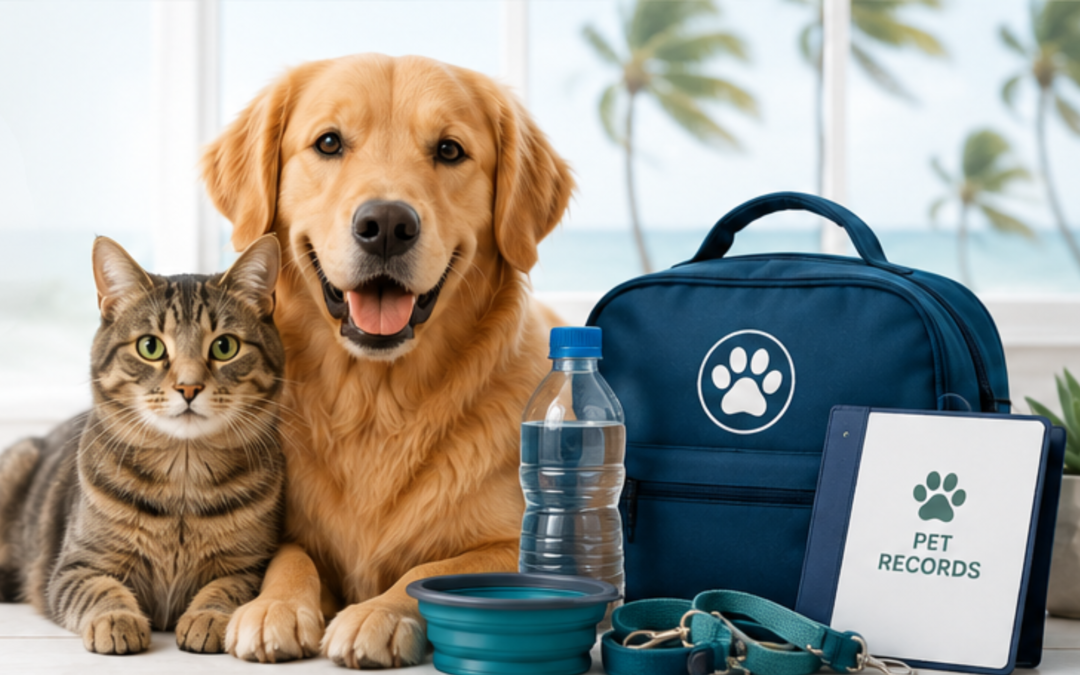
When hurricane season arrives in South Florida, preparing your household means preparing for every member of your family—including the four-legged ones.
For pet owners in Lake Worth and surrounding communities, having a hurricane plan for your pets can make an already stressful situation much safer. A little preparation before a storm can help ensure that you have the food, medications, identification, and other important records your pet may need if you lose power or need to evacuate.
At Regal Animal Hospital, we encourage pet owners to think about their pet’s emergency supplies just as they would their own. A pet hurricane emergency kit or “go-bag” should be assembled well before a storm is approaching—not when hurricane warnings have already been issued.
Table of Contents
Why Hurricane Preparedness Matters for Pets.
Palm Beach County may experience hurricanes, storm surge, heavy rainfall, flooding, high winds, and extended power outages during the peak season. Even if you do not live in an evacuation zone, your pet may still need to remain indoors and could require additional food, water, medication, or medical care following a storm.
Palm Beach County Animal Care and Control recommends that pet owners prepare identification, emergency supplies, transportation, shelter arrangements, medications, and vaccination records before hurricane season. The county also emphasizes that pets should never be left behind when evacuating.
The most important rule is simple: If it is not safe for you to stay, it is not safe for your pet to stay.
Steps You Can Take to Prepare for an Emergency
Build a Pet Hurricane “Go-Bag”
One of the easiest ways to prepare is to create a dedicated emergency bag or waterproof container for your pet. Keep it somewhere that is easy to access. We also recommend checking its contents periodically to make sure items with expiration dates are still usable and important information remains current.
Consider including:
- Food: At least 5–7 days of your pet’s regular food. Store dry food in a waterproof container or resealable bags.
- Water: An adequate supply of bottled or stored water for your pet. Palm Beach County recommends at least three days of food and water for pets, while its Pet Friendly Shelter checklist calls for a five-day supply.
- Food and water bowls: Collapsible bowls can save space.
- Medications: Keep at least five days of necessary medications available, and ask your veterinarian or pharmacy about obtaining additional medication before a storm.
- Leash and collar: Keep a sturdy leash and properly fitted collar with your pet.
- Pet carrier or crate: Cats and small pets should have a secure carrier. Make sure your pet is familiar with it before an emergency occurs.
- Litter and litter box: For cats, include disposable or travel-size supplies when possible.
- Waste bags: Include plenty of bags for cleaning up after dogs.
- Bedding or blanket: Familiar bedding can provide comfort in an unfamiliar environment.
- Towels: Useful for drying wet pets, cleaning paws, or creating a comfortable resting area.
- Pet first-aid supplies: Include basic supplies recommended by your veterinarian.
- Favorite toy or comfort item: Familiar objects can help reduce stress.
- Grooming supplies: Include a brush or other routine grooming items your pet may need.
- Recent photographs: Keep current photos of your pet in your emergency kit and on your phone.
- Veterinary records: Store vaccination records, medication information, medical history, and your veterinarian’s contact information in a waterproof bag.
- Proof of ownership: Include documentation and recent photographs of you with your pet.
- Microchip information: Record your pet’s microchip number and the registry’s contact information.
- County license and rabies tag: Keep these current and attached to your pet’s collar.
Palm Beach County’s own Pet Friendly Shelter checklist includes food and water, bowls, waste bags, litter, a carrier, leash and collar, medications, identification, microchip information, county license and rabies tag, and waterproof veterinary and ownership records.
Don’t Forget Your Pet’s Medication
If your dog or cat takes prescription medication, hurricane preparation should include a medication plan.
Do not wait until a hurricane is approaching to request a refill. Ask your veterinarian how much medication you should keep on hand and how to safely store medications if your home loses power.
If your pet requires refrigerated medication or specialized medical equipment, discuss an emergency plan with your veterinarian before hurricane season.
Make Sure Your Pet Can Be Identified
A hurricane can be frightening for animals. Loud noises, unfamiliar surroundings, open doors, damaged fences, and evacuation can increase the risk that a pet could escape or become separated from its family.
Microchipping is one of the most important steps you can take to improve the chances of being reunited with a lost pet. Make sure:
- Your pet has a functioning microchip.
- The microchip is registered.
- Your telephone number and address are current in the microchip registry.
- Your pet wears a collar with current identification.
- Your pet’s license and rabies tag are current when applicable.
Before hurricane season, ask your veterinary team to scan your pet’s microchip and confirm that the number matches your records.
Keep Your Pet’s Vaccinations Current
An emergency shelter, boarding facility, or hotel may require proof that your pet’s vaccinations are current.
Keeping your pet up to date on recommended vaccines also helps protect them when they are around unfamiliar animals in shelters or temporary boarding environments.
At Regal Animal Hospital, we can also help you make sure your pet’s medical records are current before hurricane season.
Know Where You Will Go Before You Need to Evacuate
One of the biggest mistakes pet owners can make is assuming they will “find somewhere” to go after an evacuation order is issued.
Plan your destination before a storm.
Palm Beach County operates hurricane evacuation shelters, but it’s important to note that pets are not permitted in general population shelters. The county has a designated Pet Friendly Shelter, but space is limited. The county’s designated Pet Friendly Shelter is located at:
West Boynton Recreation Center
6000 Northtree Blvd.
Lake Worth, FL 33463
According to Palm Beach County, the shelter is available to Palm Beach County residents who live in a mandatory evacuation zone, a mobile home, or substandard housing. Proof of residency is required.
The shelter accepts dogs and cats, with separate housing areas for different types of animals. The county’s current guidance states that equines, livestock, small barnyard animals, exotic pets, and reptiles are not accepted. Aggressive dogs may also be refused if staff determine that handling the animal would be unsafe.
There is another important detail for families considering this option: Pet owners do not stay inside the Pet Friendly Shelter with their animals.
After checking their pets into the Pet Friendly Shelter, owners and family members proceed to the adjacent Park Vista High School shelter for human sheltering.
Because space is limited, Palm Beach County recommends considering the Pet Friendly Shelter a last-resort option and making other arrangements whenever possible.
Important: Check the County’s Current Storm Instructions
Shelter operations, locations, eligibility requirements, hours, and availability can change depending on the storm. Before evacuating, check:
- Palm Beach County Pet Friendly Shelter information
- Palm Beach County Hurricane Evacuation Shelters
- Palm Beach County Office of Emergency Management – Pets Planning
- Palm Beach County Hurricane Preparedness Information
Do not assume that a shelter listed online will be open for every storm. Palm Beach County notes that shelter openings and locations can change according to storm circumstances.
Consider a Pet-Friendly Hotel or Boarding Facility
For many families, a pet-friendly hotel, boarding facility, family member, or friend outside the evacuation area may be a better option than a public shelter.
Make arrangements before hurricane season whenever possible.
When researching a pet-friendly hotel or boarding facility, ask:
- Does the facility accept pets during an active hurricane evacuation?
- Does it require proof of vaccinations?
- Are there breed, size, or species restrictions?
- Are there additional emergency or evacuation fees?
- Can you make a reservation in advance?
- What happens if the storm changes direction?
- Does the facility have backup power?
- How far is it from the evacuation zone?
- What supplies should you bring?
Do not assume that a hotel that normally accepts pets will continue accepting them during a hurricane. Call ahead and confirm the property’s emergency policy.
Practice Before the Storm
Your pet’s emergency plan should not begin when the evacuation order is issued.
If your dog is uncomfortable in the car, begin practicing short trips. If your cat hides whenever the carrier appears, leave the carrier out in the home and gradually make it a familiar, comfortable space.
Make sure pets are comfortable wearing their collars and that dogs can walk calmly on a leash.
For pets that become extremely anxious during storms, talk with your veterinarian before hurricane season. Your veterinarian may be able to recommend behavioral strategies or, when appropriate, medications to help manage severe storm anxiety. However, you should never give your pet a medication or sedative that was not prescribed or specifically recommended for them by a veterinarian.
What to Do When a Hurricane Is Approaching
When a storm is approaching, don’t wait until the last minute to put your plan into action.
If you are staying home:
- Bring pets indoors well before tropical-storm-force winds arrive.
- Keep pets away from windows and exterior doors.
- Put carriers, leashes, medications, and emergency supplies somewhere accessible.
- Fill water containers for both people and pets.
- Keep your pet’s collar with ID on them.
- Keep your pet in a secure room away from potential hazards.
- Avoid allowing dogs or cats outdoors unless absolutely necessary.
- Keep cats indoors, even if they normally spend time outside.
Palm Beach County specifically advises that all pets should be brought indoors during a hurricane.
If you are evacuating:
Take your pets with you. Do not leave a dog, cat, or other companion animal behind because you assume you will be able to return later. Before leaving:
- Put your pet’s collar and identification on them.
- Secure cats and small animals in carriers.
- Keep dogs on leashes.
- Pack the pet go-bag.
- Take medications and medical records.
- Confirm that your destination is accepting pets.
- Check current road and evacuation conditions.
- Leave early enough to avoid worsening traffic and hazardous conditions.
Palm Beach County’s emergency management guidance specifically advises residents who evacuate to bring their pets unless other arrangements have been made.
After the Hurricane: Be Careful When Returning Home
The danger doesn’t necessarily end when the storm passes. Floodwater, downed power lines, broken glass, exposed nails, damaged fences, debris, contaminated water, wildlife, and unstable structures can all pose hazards to pets.
Before allowing your pet outside, inspect the area carefully. Keep your dog on a leash and your cat indoors until you are confident that your property and surrounding area are safe.
If your pet becomes lost, contact Palm Beach County Animal Care and Control and check local lost-and-found resources. The county maintains lost-and-found services and encourages microchipping because identification can help reunite pets with their families.
Your Pet Hurricane Preparedness Checklist
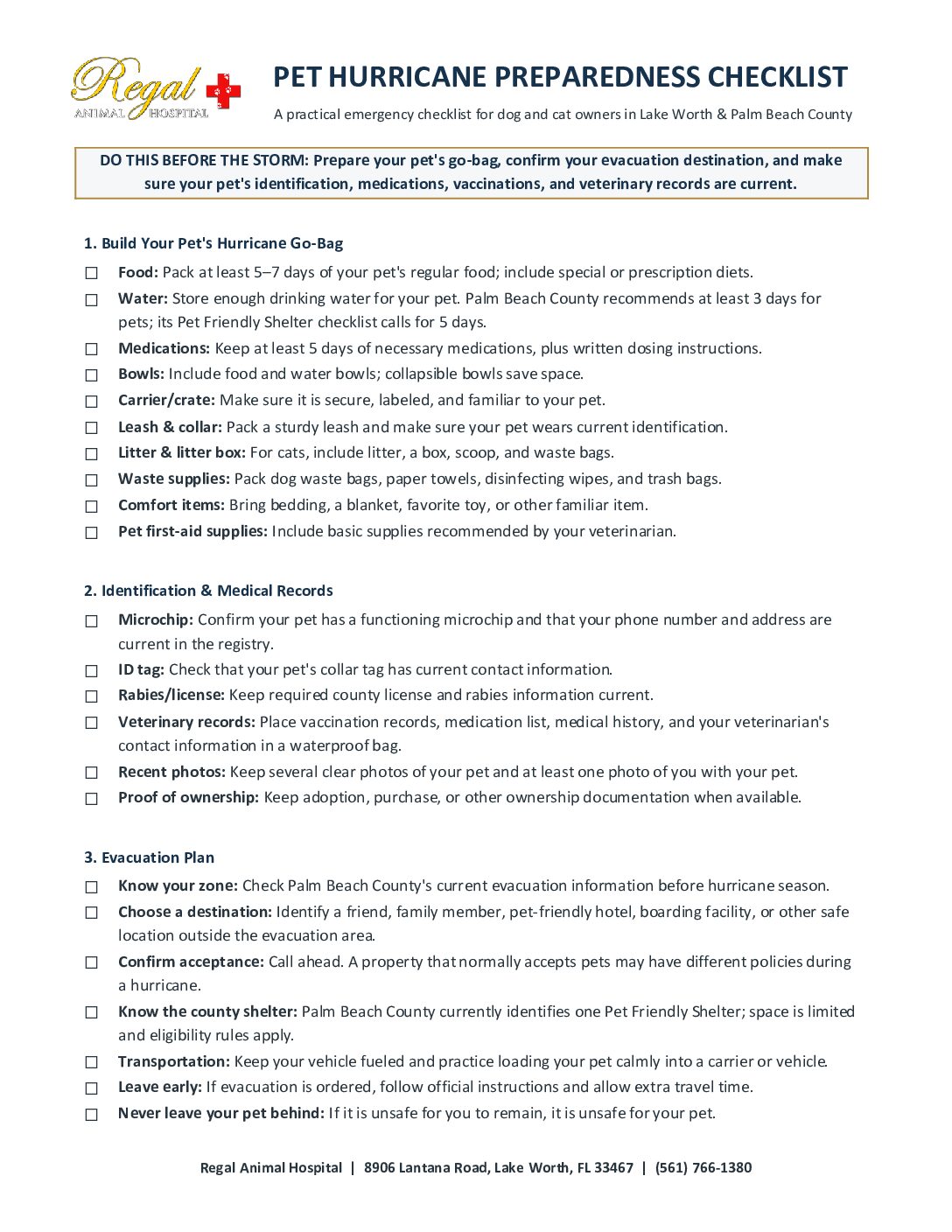
To help you prepare, we’ve put together a checklist that you can use to prepare your pet’s emergency “go bag”. Download your copy here.
A Little Preparation Can Make a Big Difference
Hurricanes are stressful for everyone—including our pets. But preparing a pet emergency kit, keeping identification and medical records current, knowing where you can evacuate, and discussing your pet’s individual needs with your veterinarian can make an emergency much more manageable.
Most importantly, don’t wait for a hurricane warning to make your pet’s plan.
Prepare the go-bag now. Know where you will go. Keep your pet’s medical information current. And make sure every member of your household knows the plan.
If you have questions about your pet’s vaccinations, medications, microchip, medical records, anxiety during storms, or other hurricane preparedness needs, contact Regal Animal Hospital before the next storm is approaching. Our veterinary team is here to help families throughout Lake Worth and Palm Beach County keep their pets safe, healthy, and prepared.

Send us a Message

Visit Our Office

Call Us Today
